01
Know where to land
Train your ears and fingers to land on, accent and highlight the right notes as the chords change.
 looped clip
 by Roy Ziv
A guitar improvisation gym with interactive, game-like exercises that train note choice, rhythm, and the ability to create your own licks in real time.







A system for turning what you know into improvisation you can actually use, in real time.
Train your ears and fingers to land on, accent and highlight the right notes as the chords change.
looped clipHear a rhythm, play it back with your own notes, then improvise inside play, hold and rest patterns, so your lines breathe and take shape instead of running nonstop.
 looped clip
Get comfortable in every area of the neck, and connect it all together smoothly.
 looped clip
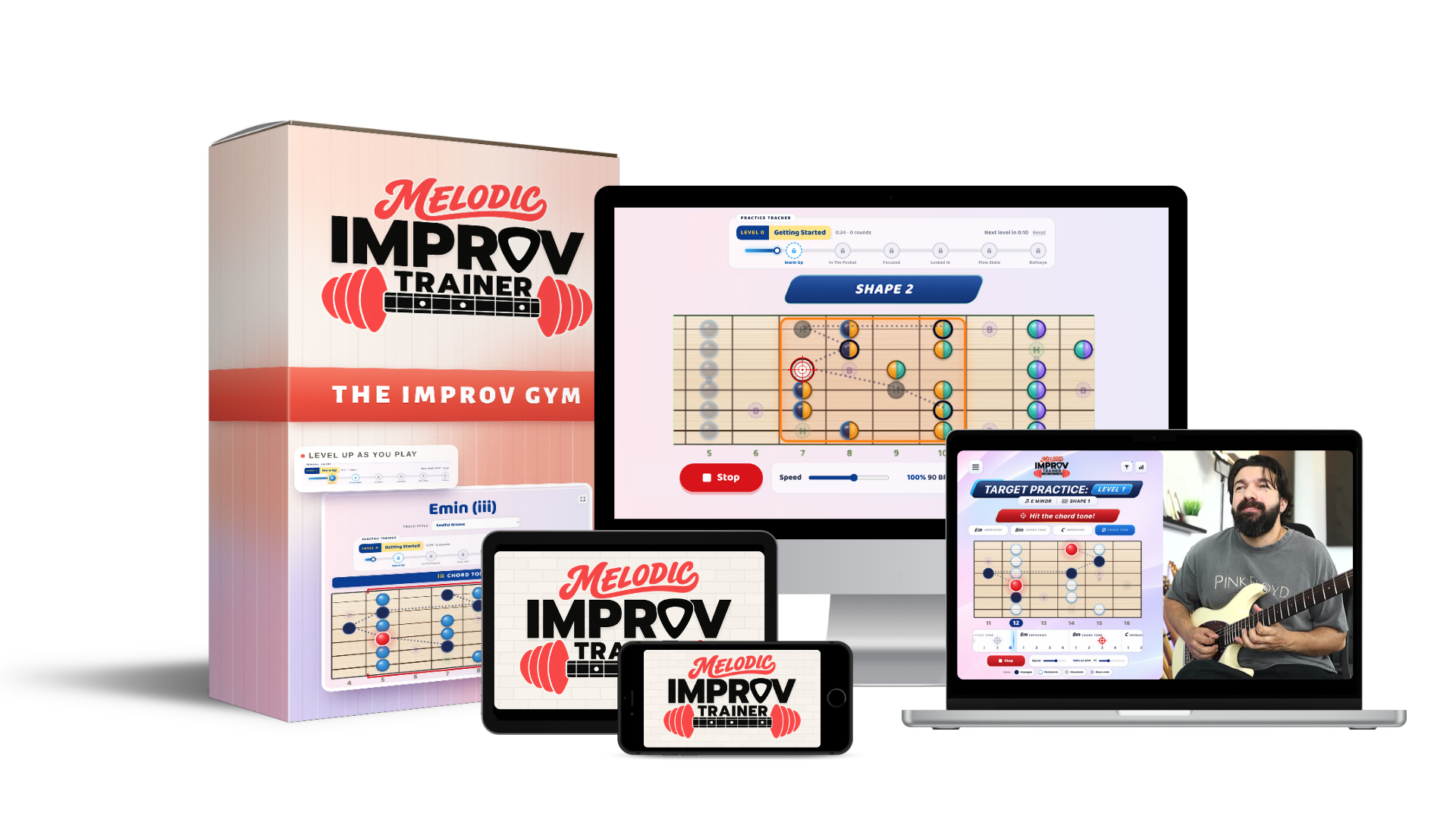
The Melodic Improv Trainer is the most complete training system for guitar players, designed to turn scales, licks and musical ideas into real-time melodic improvisation skills you’ll actually use. Automatically.
Each week, you’ll work through guided exercises and challenges that use simple musical restrictions to stop your hands from running back to the same habits.
Step by step, you move from controlled exercises into free improvisation, until melodic improv starts showing up naturally in your solos.
Because the exercises happen while you’re improvising. You’re practicing the exact moment most players get stuck:
Making better musical decisions in real time.
This is not a course you passively watch. You press play, pick up your guitar, and complete the exercises in real time.
Watch Roy play along with the Trainer, improvising in real time, trying to hit the targets.
*Note: Roy is pushing these exercises way past where most students start. You’ll start much simpler, and the app lets you slow things down and go at your own pace.
Built for the guitarist who can already play, but doesn’t sound the way he wants to when he improvises. Whether you’ve been playing for 3 years or 30, does this sound familiar?
My solos sound like I’m running scales, not playing music.
I keep falling back on the same licks and patterns.
I’m stuck in the same pentatonic box.
I have the technique, it just doesn’t sound melodic.
I lose track of the chords and guess which notes will work.
I can’t play what I hear in my head.
Everything I learn never shows up when I actually improvise.
I can’t phrase my lines in a cool way. They all have the same rhythm.
Sounding musical is a set of skills,
and skills can be trained.
Wherever you’re at, there’s a way in:
You know the first pentatonic box and you’ve tried a few solos. Optional refreshers cover the essential theory and phrasing basics, so you’re never left guessing.
Start with the refreshersYou can play licks, scales and your favorite solos, but when you improvise it comes out the same way every time. The Trainer was built to get you out of exactly that rut.
Start at Challenge 1Great technique, but your lines don’t sound melodic, you lose your place in fast progressions, or your phrases have no real shape. You’ll learn to phrase with intention, follow fast changes without guessing, and use upper extensions for richer, grown-up colors.
Go deeperMore melodic.
More expressive.
More connected to the chords.
More confident in your phrasing and note choices.
The training helps you:
Connect your phrases to the chords underneath you
Target melodic notes without stopping to think
Learn the same ideas Roy personally uses across the neck
Improvise across multiple areas of the neck, smoothly
Create lines that sound connected and intentional
Understand the techniques behind Roy’s jazzy, fusion-style sound
A progressive journey that starts with focused practice and builds toward free improvisation across the neck.
All the theory you’ll need to fully understand the rest of the course, explained in plain language. Skip it if your theory is strong.

Rhythm and space are half of sounding melodic. Here’s how you train them.
Scales and arpeggios across the entire neck, and how to connect them smoothly.
Land the right notes at the right time, without stopping to think.
Invent your own lines instead of recycling memorized ones.

The richer, grown-up sounds behind Roy’s jazzy, fusion-style playing.
Real grooves, levels to climb and a clear goal every time you press play.
Just follow along. No more sitting down and wondering what to work on.
Exercises get harder as you improve, so you’re always challenged but never lost.
Every lesson and practice app works on your computer, tablet and phone.
Watch Roy improvise using the exact ideas you’ll train inside the course.
Everything you hear is 100% improvised.

I’ve helped thousands of guitarists improve their playing. My work has been featured in Guitar World and MusicRadar, and I’ve been a guest speaker at Berklee College of Music.
Every course I make starts the same way: I figure out what I’m already doing when I solo, then find the method inside it. When I did that with my improvising, I found 90% of my playing comes down to one idea. The Melodic Improv Trainer is how I drill that idea into your fingers, step by step.
I had a lot of fun creating this program, and I’ve spent countless hours myself playing around with the exercises. They really do feel like a game. I hope you enjoy practicing with them as much as I do.



As a recreational guitar player for the past decades, this has been a game changer for me, providing exactly what I needed to make more progress in my soloing in the past couple of months than in the previous twenty years.
Lars D.I never thought I'd actually be able to turn the musical ideas in my head into something I can really play! Thank you for this amazing course! It's opening up a whole new world for me!
 Massimo
Before this, I struggled with playing solos melodically and with structure. After a couple of months, I have already seen leaps and bounds in my playing that I haven't seen in years.
Daniel K.After 30 years of playing guitar and searching through thousands of YouTube videos, I finally found a way that works.
Carl B.I love the systematic approach. The exercises prevent me from noodling around in my comfort areas of the fretboard. After a few weeks, I definitely feel more comfortable, confident, creative, and intentional with the way I am improvising.
Juanma G.In most courses they only focus on arpeggios. Roy teaches phrasing, rhythms and structures, and how he incorporates chord tones himself. That was a huge lightbulb moment for me.
 Tim I.
I tried to put into practice your tip of keeping an idea for more than one chord. It helped me a lot! The last part of the challenge also helped me a lot to gain more freedom and feel less trapped in one box. I also started to explore other positions of the pentatonic. Total game changer!
 Daniel A.
Roy's focus on chord tones and taking things step by step is certainly helping. I feel like I'm hitting fewer obviously 'wrong' notes now.
 Eddy H.
The challenges have made me more focused during my practice than I often am when working on a subject on my own.
Anthony W.
Full access
Black Friday launch price
Start Training NowOne-time payment · Lifetime access


The Melodic Improv Trainer is a complete guitar improvisation program that combines video lessons with interactive, game-like practice apps.
Instead of just learning new scales, licks, and concepts, you’ll spend most of your time actually improvising over real backing tracks while following guided exercises.
The goal is to train your fingers and ears to find the right notes, create your own musical ideas, and improvise comfortably across the entire neck, until those skills start becoming second nature.
Think of it as a gym for guitar improvisation.
Most guitar courses teach you something, show you a few examples, and then leave you to figure out how to use it in your own playing.
The Melodic Improv Trainer takes a different approach.
Each skill is broken down into focused exercises that you practice directly inside the interactive trainer, over real music.
You’ll learn something, train it through repetition, and gradually put it to use in your own improvisation.
You’re not just watching Roy demonstrate what to play. You’re spending time training yourself to actually do it.
Every exercise has its own interactive trainer built directly into the course.
You’ll see a guitar fretboard on screen with visual guidance showing you which notes to practice, where to land, or when to play and rest, depending on the exercise.
Press play, grab your guitar, and follow along with a real backing track.
Some exercises train you to land on specific notes as chords change. Others work on your rhythm, phrasing, creating your own licks, or moving between pentatonic shapes.
As you progress, the exercises become more challenging and give you more freedom to improvise.
No. The trainer is a visual, play-along practice system, not a guitar note-detection app.
It shows you what to practice and when, while you play along with the music. You’ll use your ears and the on-screen guidance to check your playing.
The goal is to gradually become less dependent on the visual guides as your ears and fingers learn to recognize where to go.
It’s designed for guitarists who already have some experience playing lead guitar but struggle to improvise the way they want.
Maybe you know your pentatonic shapes but keep playing the same licks. Maybe you have decent technique, but your solos sound like you’re running scales. Or perhaps you can play other people’s solos beautifully but struggle to come up with your own ideas.
Whether you’ve been playing for a few years or a few decades, if you want to get better at creating your own melodic solos, this program was designed for that.
You don’t need to be an advanced guitarist, but you should have some basic lead guitar experience.
Ideally, you can already play at least the first minor pentatonic shape and have tried improvising or playing a few solos.
The program includes optional theory and phrasing refreshers, so you don’t need an extensive understanding of music theory before starting.
If you’re completely new to guitar, I’d recommend learning the fundamentals and your first pentatonic scale before joining.
Not at all!
One of the main goals of the Trainer is to get you comfortable improvising in all five shapes and connecting them across the fretboard.
We start with Shape 1, then gradually introduce new positions and connections.
Even if you already know every shape, the exercises will challenge you to use them in ways you might not be used to.
No advanced theory is required.
There’s an optional Essential Theory section covering scale degrees, chord numbers, chord tones, and the pentatonic and hexatonic scales.
If you already understand these concepts, you can skip the refresher.
The program focuses on putting musical ideas into practice, not memorizing more theory.
Yes, that’s one of the main skills we’re training, but there’s an important distinction.
Rather than trying to memorize the chord tones of every possible chord at once, we focus our chord-targeting exercises on two especially useful chords.
You’ll train yourself to hear those changes coming and land on notes that bring out the sound of each chord, while continuing to improvise with your familiar pentatonic shapes.
We’ll practice this across the neck, gradually building up to exercises over longer chord progressions.
The goal is to develop the ear-to-finger connection needed for more melodic playing, without overwhelming you with every chord at once.
Absolutely. That’s one of my favorite parts of the program.
You’ll learn what I call Lick Starters: short musical ideas that you can take in different directions.
Rather than memorizing a long lick note for note, you’ll practice changing the rhythm, extending it, moving it around the fretboard, and coming up with your own variations.
You’ll also work on rhythmic exercises and phrasing structures that encourage you to experiment with your own notes and ideas.
The goal isn’t to make you sound exactly like me. It’s to give you more tools to create your own solos.
Yes!
Choosing the right notes is only part of sounding musical. How you play those notes matters just as much.
You’ll practice exercises that help you develop better rhythm, create space, use rests, and organize your improvised lines.
Some exercises have you listen to a rhythm and play it back using your own notes. Others give you repeating patterns of playing, holding notes, and resting while you’re free to improvise.
This isn’t a complete course on every aspect of phrasing, but these exercises are an important part of the Trainer.
I’d recommend aiming for four or five practice sessions a week, even if they’re relatively short.
You don’t need to complete dozens of exercises every day.
Just open the next lesson, follow the exercise, and spend some time improvising with the backing track.
Some exercises might become comfortable quickly. Others might take a few sessions.
The important thing is to practice consistently and get comfortable with each skill before moving forward.
The Trainer is designed as a progressive training journey, roughly three months if you practice consistently.
But there’s no need to rush.
Some guitarists will move through the exercises faster, while others will benefit from spending longer on particular challenges.
The goal isn’t to finish as many lessons as possible. It’s to develop skills that actually show up in your playing.
That’s intentional.
The program starts with simple musical challenges, sometimes involving just one pentatonic shape, one chord, or one target note.
These restrictions let you concentrate on developing a particular skill without trying to think about everything at once.
As you become more comfortable, the exercises gradually introduce more notes, different rhythms, new shapes, and more freedom.
Even if you already know the material, being able to use it automatically while improvising is an entirely different skill.
Yes. The interactive trainers are designed to work on desktop computers, tablets, and phones.
For the best experience, I recommend using a larger screen, such as a laptop or tablet, so you can easily see the fretboard and visual guides while playing.
On phones, you can use the trainer in landscape orientation.
There’s no special hardware or MIDI guitar required.
You’ll practice over real backing tracks in a variety of musical styles, including rock, blues, funk, soul, softer grooves, progressive styles, and synth-inspired tracks.
Many exercises let you choose between different tracks, so you can practice the same skill over different musical feels.
The idea is to make the repetition enjoyable and help you develop these abilities while playing actual music.
No. Melodic Improv Trainer is offered as a one-time purchase with lifetime access to the purchased course and its included training apps.
You can return to the lessons and exercises whenever you want, without needing to finish everything within a specific deadline.
You’re covered by a 30-day money-back guarantee.
Practice with the Trainer for 30 days. If you’re not improving and enjoying your practice, email us within 30 days and we’ll refund every cent.
Yes.
My other courses focus on particular areas of guitar playing, such as speed, scales, modes, or musical vocabulary.
Melodic Improv Trainer is specifically focused on developing your ability to improvise in real time.
It combines a structured curriculum with interactive practice apps that train how you use the notes, scales, and ideas you already know.
If you’ve taken my other courses, a lot of what you’ve learned can become useful material to explore inside the Trainer.
Then this could be particularly useful for you.
Knowing scales, arpeggios, and licks is one thing. Being able to use them naturally while improvising is something else entirely.
You might be able to play a difficult solo note for note but still fall back on the same familiar patterns when you improvise.
The Trainer focuses on that gap between what you know and what your fingers actually do when the backing track starts.
Yes. The interactive Trainer includes a practice tracker with levels that reward your practice time and consistency.
You’ll also be encouraged to record an improvised solo before beginning the program and record another over the same backing track after completing it.
That gives you a way to listen back and compare your playing over time.
You don’t need to sound perfect at every exercise before moving on. The goal is steady improvement, not perfection.
Tap any section to see every lesson inside it.
Built with the feedback of over 200 guitaristsEverything you need to improvise melodic solos across the neck, automatically.
Full access
Black Friday launch price
Start Training NowOne-time payment · Lifetime access